

"When efficiency and precision matters"
www.africansurveyors.com
“The greatest obstacle to discovery is not ignorance—it is the illusion of knowledge.” — Daniel J. Boorstin
In the world of subsurface exploration, Ground Penetrating Radar (GPR) is revolutionizing how we detect and analyze underground utilities. At African Consulting Surveyors, we leverage GPR to provide accurate, non-invasive insights into the hidden infrastructure beneath our feet.
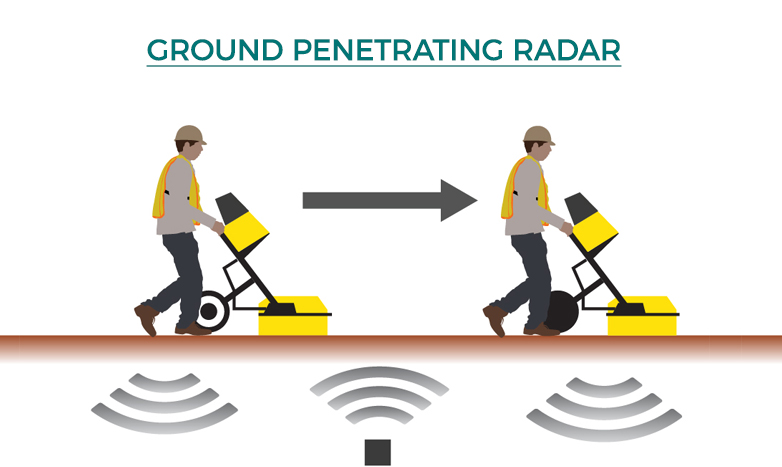
Ground Penetrating Radar is a non-destructive geophysical method that uses radar pulses to image the subsurface. By transmitting high-frequency radio waves into the ground and analyzing the reflected signals, GPR can detect objects, changes in material, and voids. This technology is invaluable for locating both metallic and non-metallic utilities, such as PVC pipes, which traditional electromagnetic methods might miss.
Traditional utility detection methods often struggle with non-metallic materials. GPR overcomes this limitation by identifying differences in dielectric properties, allowing for the detection of plastic, ceramic, and concrete utilities.
While GPR cannot specify the exact material composition, it can distinguish between metallic and non-metallic objects based on signal reflection strength. This differentiation aids in risk assessment and excavation planning.
GPR provides depth estimates by calculating the time it takes for radar pulses to return to the surface. This information is crucial for understanding the positioning of utilities and planning safe excavation activities.
By conducting grid scans, GPR can create detailed maps of subsurface features, revealing the layout of utilities and potential obstructions. This comprehensive view aids in project planning and reduces the risk of unexpected encounters during construction.
GPR data can be integrated with other surveying methods, such as LiDAR, to enhance site analysis. Understanding what is a lidar map is essential; LiDAR uses laser pulses to create high-resolution maps of the Earth's surface, complementing GPR's subsurface insights.
Despite its advantages, GPR has limitations. Its effectiveness decreases in highly conductive soils, such as clay, where signal penetration is reduced. Additionally, GPR cannot assess the condition of utilities or determine specific material types without supplementary data.
In the context of energy infrastructure, understanding the coal plant process involves mapping extensive underground systems. GPR aids in identifying the layout of pipelines and cables, ensuring efficient maintenance and upgrades.
Hydrographic survey equipment, used to map underwater features, benefits from GPR when assessing coastal and riverine environments. GPR complements sonar technologies by providing data on shallow subsurface conditions, enhancing the accuracy of hydrographic surveys.
GPR is a valuable tool among the various types of engineering survey techniques. It enhances traditional methods by providing subsurface data, which is critical for designing foundations, assessing site stability, and planning infrastructure projects.
The difference between 2D and 3D modelling is significant in engineering. While 2D models offer flat representations, 3D models provide a more comprehensive view, incorporating depth and spatial relationships. GPR data contributes to the development of accurate 3D models, improving visualization and decision-making in construction and design.
Ground Penetrating Radar is transforming how we approach utility detection and site analysis. At African Consulting Surveyors, we harness this technology to provide detailed, accurate subsurface information, enhancing safety and efficiency in various projects. By integrating GPR with other surveying methods and embracing advancements in modeling, we continue to lead in delivering comprehensive geospatial solutions.
For more information on our services and how GPR can benefit your project, visit our website or contact our team of experts.